

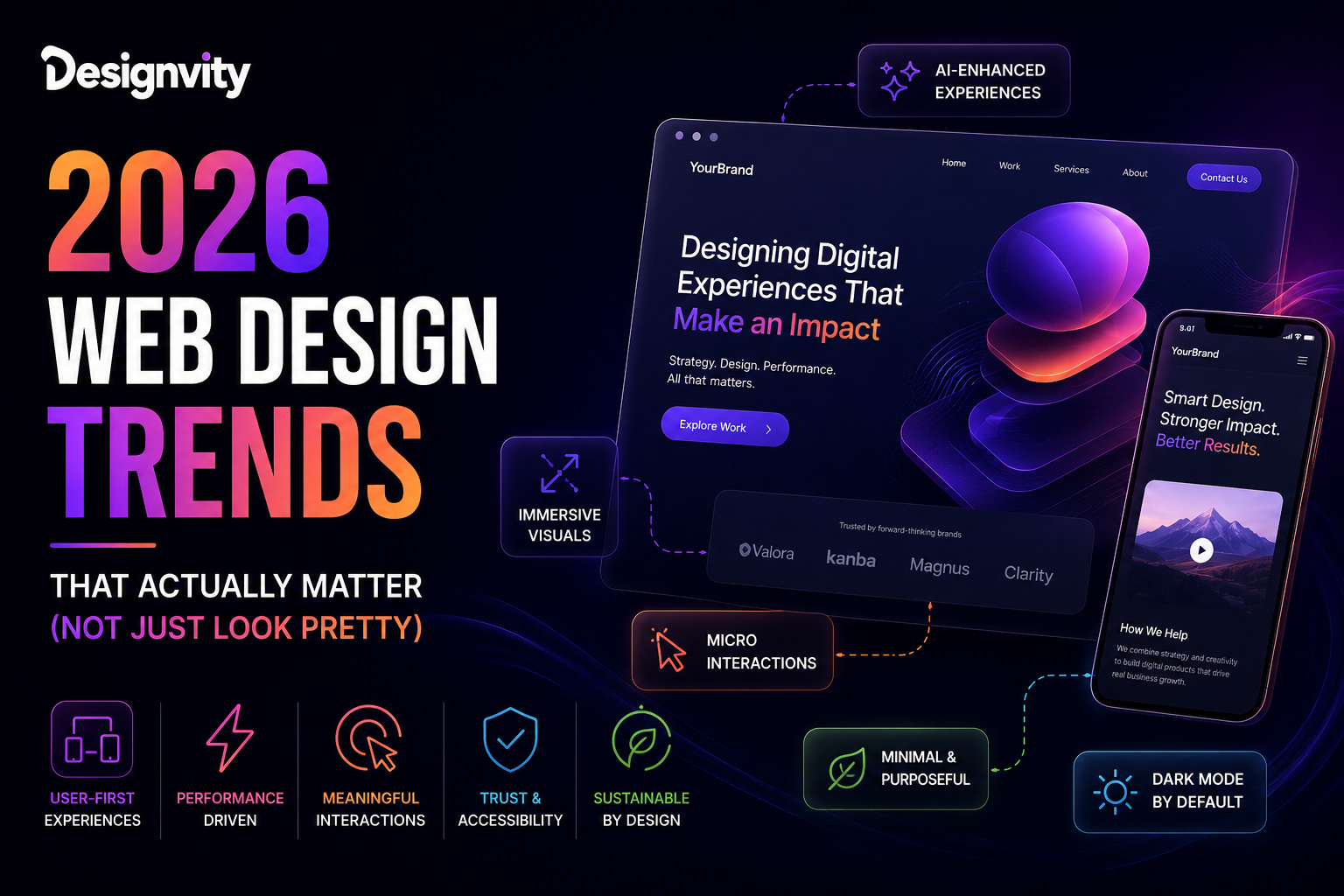
Every year, the design world is flooded with predictions about the “next big trend.” While some trends create visually stunning websites, many fail to improve what actually matters—user experience, conversions, and business growth.
In 2026, successful websites won’t be the ones with the flashiest animations or the boldest gradients. They’ll be the ones that help users find information quickly, build trust instantly, and guide visitors toward taking action.
Modern web design is shifting from decoration to performance. Businesses are investing in designs that reduce friction, improve accessibility, increase engagement, and convert visitors into customers.
In this guide, we’ll explore the 2026 web design trends that truly matter—not because they’re fashionable, but because they improve usability, performance, and conversions.
Why Functional Design Wins in 2026
A beautiful website means little if users struggle to navigate it.
Today’s users expect:
- Fast loading pages
- Clear navigation
- Mobile-first experiences
- Accessible interfaces
- Personalized content
- Frictionless interactions
Good design solves problems. Great design also grows revenue.
That’s why businesses are prioritizing functional design trends over purely visual ones.
1. AI-Assisted Personalization
Personalization is becoming a standard expectation.
Websites now adapt content based on:
- Visitor behavior
- Location
- Traffic source
- Previous interactions
- Customer lifecycle stage
Instead of showing every visitor the same homepage, businesses are delivering more relevant experiences that improve engagement and conversions.
2. Minimal Interfaces with Strong Messaging
Minimalism isn’t disappearing—it’s becoming smarter.
The focus has shifted from removing elements to emphasizing what matters most.
Modern websites use:
- Clear value propositions
- Generous white space
- Simple layouts
- Strong typography
- Focused calls-to-action
Less clutter helps users make decisions faster.
3. Performance-First Design
Speed is now a design requirement.
Heavy animations, oversized videos, and unnecessary visual effects often slow websites and reduce conversions.
Performance-focused design includes:
- Optimized images
- Lightweight animations
- Efficient layouts
- Fast-loading components
- Mobile optimization
Visitors rarely wait for slow websites.
4. Accessibility by Default
Accessibility is no longer optional.
Businesses are designing for users with different abilities from the start.
Key improvements include:
- Better color contrast
- Keyboard navigation
- Screen reader compatibility
- Readable typography
- Clear focus states
- Descriptive labels
Accessible websites improve usability for everyone—not just users with disabilities.
5. Smarter Navigation
Complex navigation frustrates users.
In 2026, successful websites prioritize simplicity through:
- Fewer menu items
- Better search functionality
- Sticky navigation
- Clear information hierarchy
- Predictable layouts
Users should never wonder where to click next.
6. Interactive Micro-Interactions
Micro-interactions provide subtle feedback without distracting users.
Examples include:
- Button hover effects
- Loading indicators
- Form validation
- Success confirmations
- Progress indicators
These small interactions make websites feel more responsive and intuitive.
7. Scannable Content Layouts
Most visitors don’t read every word—they scan.
Modern websites improve readability with:
- Short paragraphs
- Clear headings
- Bullet points
- Icons
- Visual hierarchy
- Highlighted key information
Content that’s easy to scan keeps users engaged longer.
8. Conversion-Focused Landing Pages
Landing pages are becoming more intentional.
Instead of overwhelming users with information, businesses focus on guiding visitors toward a single goal.
Effective landing pages include:
- Clear headlines
- One primary CTA
- Trust signals
- Customer testimonials
- Benefit-driven messaging
- Minimal distractions
Every section should move users closer to conversion.
9. Human-Centered AI Experiences
AI is becoming part of the user experience—but thoughtfully.
Businesses are integrating:
- AI-powered chat assistants
- Smart search
- Personalized recommendations
- Automated onboarding
- Dynamic FAQs
The goal is to assist users, not overwhelm them.
10. Strong Visual Hierarchy
Good design tells users where to look first.
Modern websites achieve this through:
- Typography scale
- Strategic spacing
- Color contrast
- Visual grouping
- Consistent layouts
A strong hierarchy reduces cognitive load and improves usability.
11. Mobile-First Everything
Mobile traffic continues to dominate.
Designers now build for small screens first before adapting to desktop.
Key priorities include:
- Thumb-friendly navigation
- Responsive layouts
- Fast mobile loading
- Simplified forms
- Touch-friendly buttons
A mobile-first approach improves the experience across all devices.
12. Trust-Building Design
Visitors make decisions within seconds.
Modern websites build confidence through:
- Client logos
- Customer reviews
- Case studies
- Certifications
- Transparent pricing
- Secure payment indicators
- Professional branding
Trust often has a greater impact on conversions than visual effects.
Design Trends That Are Losing Impact
Not every popular trend improves usability.
Businesses should avoid overusing:
- Excessive animations
- Auto-playing videos
- Complex scrolling effects
- Hidden navigation
- Tiny fonts
- Decorative 3D elements without purpose
- Overly abstract layouts
If a design choice slows users down, it’s working against your business goals.
How to Evaluate Whether a Trend Is Worth Following
Before adopting any trend, ask:
- Does it improve usability?
- Does it support business goals?
- Will it increase conversions?
- Does it load quickly?
- Is it accessible?
- Does it simplify the user journey?
- Will it still feel relevant in two years?
If the answer is “no,” it may not be worth implementing.
Measuring the Success of Modern Web Design
The best designs are measured by performance—not appearance.
Track metrics such as:
- Conversion rate
- Bounce rate
- Average session duration
- Lead generation
- Form completion rate
- Customer engagement
- Core Web Vitals
- Revenue per visitor
Data should guide future design decisions.
Why Ongoing Design Improvements Matter
A website isn’t a one-time project.
As customer behavior, technology, and business goals evolve, continuous improvements help maintain strong performance.
Regular updates include:
- Refining layouts
- Testing CTAs
- Updating visuals
- Improving accessibility
- Optimizing page speed
- Refreshing content
Continuous optimization keeps websites competitive.
Why Choose Designvity?
At Designvity, we believe great web design is measured by business results—not just visual appeal.
Our Unlimited Graphic Design Subscription helps businesses create high-performing digital experiences with services including:
- Website UI/UX Design
- Landing Page Design
- Conversion-Focused Web Design
- Marketing Graphics
- Brand Identity Design
- Motion Graphics
- Website Assets
- White-Label Design Support
- Design System Development
- Unlimited Design Requests and Revisions
Whether you’re launching a new website, redesigning an existing one, or continuously optimizing your digital presence, our dedicated design team delivers scalable, conversion-focused creative support that helps businesses grow without the overhead of hiring in-house designers.
People Also Search For
- 2026 web design trends
- modern website design elements
- functional design trends
- conversion-focused web design
- website UX trends
- responsive web design
- website performance optimization
- landing page design trends
- UI/UX best practices
- unlimited graphic design services
People Also Ask
What are the biggest web design trends in 2026?
Key trends include AI-assisted personalization, performance-first design, accessibility, mobile-first layouts, conversion-focused landing pages, trust-building elements, and simplified user experiences.
Are animations still important?
Yes, but they should enhance usability rather than distract users. Lightweight micro-interactions are generally more effective than excessive animations.
Why is website speed considered a design trend?
Users expect fast experiences. Optimized design directly improves page speed, user satisfaction, SEO performance, and conversion rates.
Should businesses redesign their website every year?
Not necessarily. Continuous optimization through testing, performance improvements, and user experience updates is usually more effective than complete redesigns.
Why choose Designvity?
Designvity provides unlimited design support that helps businesses create, improve, and optimize websites focused on conversions, usability, and long-term growth.
Frequently Asked Questions
Is minimalism still relevant in 2026?
Yes. However, modern minimalism focuses on clarity, usability, and communication rather than simply removing design elements.
What matters more—appearance or usability?
Both are important, but usability has a greater impact on customer satisfaction, engagement, and conversions.
How often should websites be updated?
Businesses should regularly review and improve websites based on analytics, customer feedback, performance metrics, and evolving business goals.
Can small businesses benefit from modern web design trends?
Absolutely. Many functional improvements—such as faster loading times, better navigation, and stronger CTAs—can significantly improve results regardless of company size.
How does Designvity support ongoing website improvements?
Designvity’s Unlimited Graphic Design Subscription enables businesses to request continuous website updates, landing page improvements, UI enhancements, and marketing assets without worrying about per-project design costs.
Conclusion
The most impactful 2026 web design trends aren’t about flashy visuals—they’re about creating faster, smarter, and more user-friendly experiences that help businesses achieve measurable results. From AI-assisted personalization and performance-first design to accessibility, trust-building, and conversion optimization, the future of web design is focused on functionality as much as aesthetics.
At Designvity, we help businesses turn these trends into practical, high-performing digital experiences. Whether you’re building a new website or refining an existing one, our Unlimited Graphic Design Subscription provides the creative expertise and flexibility needed to keep your brand modern, user-focused, and ready to convert more visitors into customers.