

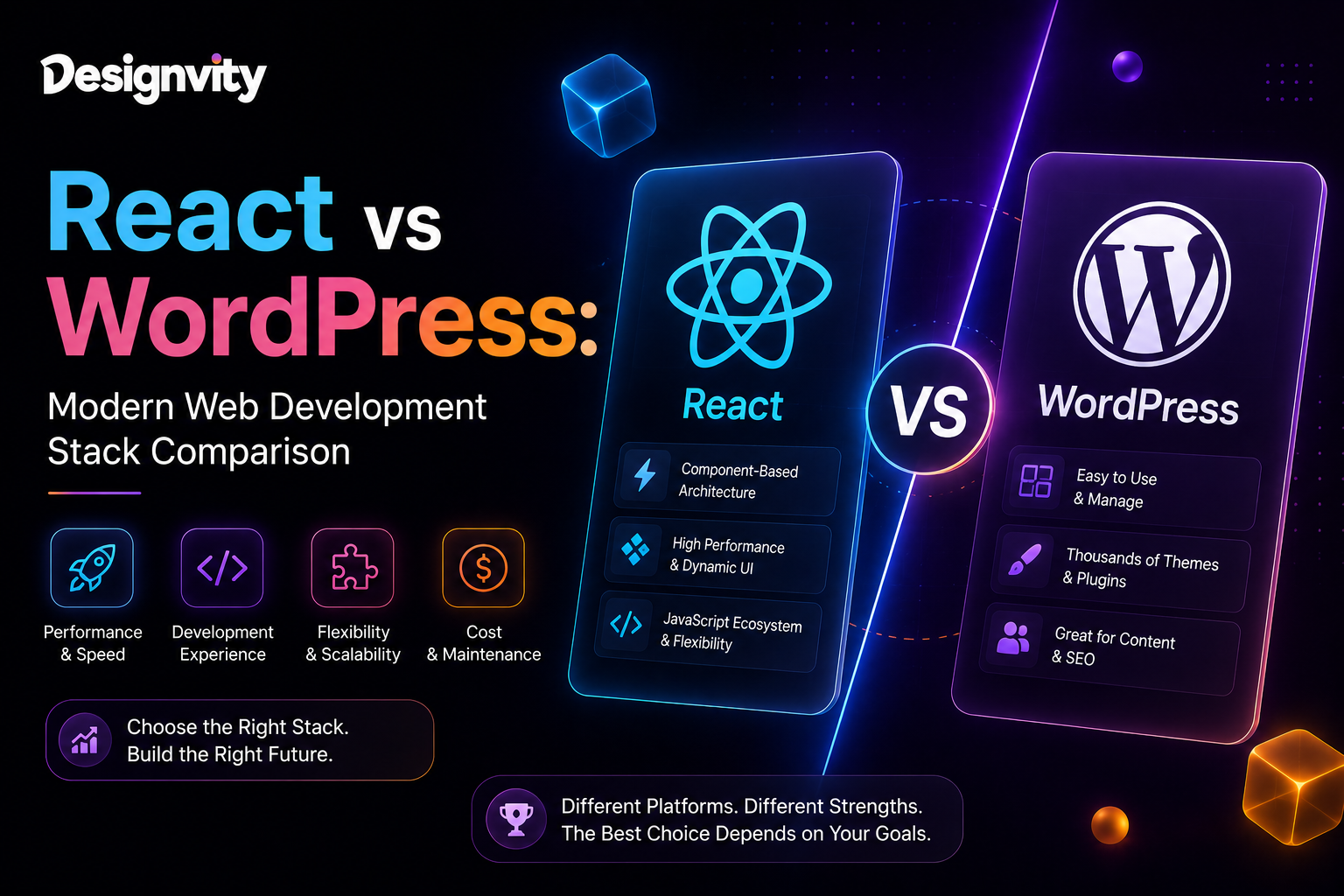
Choosing the right technology for your website can significantly impact performance, scalability, user experience, and long-term business growth.
For startups, SaaS companies, and growing businesses, one of the most common questions is:
Should we build with React or WordPress?
While developers often debate technical advantages, business owners usually care about different factors:
- Cost
- Speed to market
- SEO performance
- Scalability
- Maintenance
- Future growth
The reality is that both React and WordPress are powerful solutions, but they serve different purposes.
This guide breaks down the React vs WordPress development debate in a way that non-technical decision-makers can understand.
Understanding React and WordPress
Before comparing them, it’s important to understand what each technology actually is.
What Is React?
React is a JavaScript library developed by Meta for building modern user interfaces and web applications.
Developers use React to create:
- SaaS platforms
- Dashboards
- Web applications
- Marketplaces
- Interactive websites
- Enterprise software
React focuses on creating highly dynamic user experiences.
What Is WordPress?
WordPress is a content management system (CMS) that powers millions of websites worldwide.
It allows businesses to:
- Manage content easily
- Publish blogs
- Build business websites
- Create landing pages
- Run eCommerce stores
WordPress is designed to make website management accessible without requiring extensive coding knowledge.
Why This Decision Matters
The technology stack you choose affects:
Website Performance
Faster websites typically provide better user experiences.
SEO Visibility
Search engines prioritize websites that are optimized for speed and usability.
Scalability
Your platform should support future growth.
Development Costs
Technology decisions directly affect budgets.
Maintenance Requirements
Some solutions require more technical resources than others.
Choosing the wrong platform can lead to expensive redesigns later.
React vs WordPress: Core Differences
Purpose
React
React is primarily used for building web applications and highly interactive experiences.
Examples include:
- SaaS products
- Customer portals
- CRM systems
- AI platforms
- Marketplaces
WordPress
WordPress is designed primarily for content-driven websites.
Examples include:
- Business websites
- Blogs
- Service company websites
- Marketing websites
- Small eCommerce stores
Winner
Neither. The right choice depends on your business goals.
Performance Comparison
Performance is often one of the biggest reasons companies choose React.
React Performance
React allows developers to create highly optimized applications.
Benefits include:
- Fast interactions
- Smooth user experiences
- Dynamic content updates
- Better application responsiveness
React excels when users interact heavily with the interface.
WordPress Performance
WordPress performance depends on:
- Hosting quality
- Theme optimization
- Plugin usage
- Website architecture
A well-built WordPress website can still achieve excellent speed scores.
Winner
React for complex applications.
WordPress for content-focused websites.
SEO Comparison
SEO is a major consideration for businesses relying on organic traffic.
WordPress SEO
WordPress is widely known for its SEO flexibility.
Popular tools include:
- Rank Math
- Yoast SEO
- Schema plugins
Benefits:
- Easy metadata management
- Blog publishing
- Structured content
- Internal linking control
React SEO
Modern React applications can achieve excellent SEO when implemented correctly.
However, SEO often requires:
- Server-side rendering
- Proper technical implementation
- Experienced developers
Winner
WordPress is generally easier for businesses focused on SEO and content marketing.
Ease of Content Management
Content management is where WordPress shines.
WordPress
Teams can easily:
- Publish blogs
- Update pages
- Add media
- Manage content
No developer is required for most updates.
React
Content updates often require:
- Developer involvement
- CMS integration
- Technical workflows
Winner
WordPress
Scalability Comparison
Businesses often choose React because of long-term scalability.
React Scalability
React can support:
- Millions of users
- Complex applications
- Advanced integrations
- Enterprise platforms
Many large-scale technology companies use React-based systems.
WordPress Scalability
WordPress can scale effectively for most businesses.
However, extremely complex applications may eventually outgrow traditional CMS structures.
Winner
React
Development Cost Comparison
Budget plays a major role in platform selection.
WordPress Costs
Typical costs include:
- Hosting
- Premium themes
- Plugins
- Maintenance
Development costs are generally lower.
React Costs
React projects usually require:
- Frontend developers
- Backend development
- Ongoing technical support
Initial investment is typically higher.
Winner
WordPress
Security Considerations
Security is critical for modern businesses.
WordPress Security
Security depends heavily on:
- Plugin quality
- Updates
- Hosting provider
- Security practices
Most security issues arise from outdated plugins.
React Security
React applications often provide greater control over security implementation.
However, security still depends on development quality.
Winner
Slight advantage to React for highly customized environments.
Which Platform Is Best for Different Business Types?
Small Businesses
Recommended:
WordPress
Reasons:
- Lower cost
- Easier management
- Faster deployment
Content-Driven Companies
Recommended:
WordPress
Reasons:
- Strong SEO
- Blog management
- Marketing flexibility
SaaS Startups
Recommended:
React
Reasons:
- Interactive experiences
- Product scalability
- Advanced functionality
Enterprise Organizations
Recommended:
React
Reasons:
- Scalability
- Integration capabilities
- Performance optimization
E-Commerce Businesses
Depends on complexity.
Simple stores:
- WordPress + WooCommerce
Advanced commerce platforms:
- React-based solutions
Choosing the Right Frontend Framework
When evaluating your options, ask these questions:
Are We Building a Website or an Application?
If it’s primarily a marketing website:
WordPress is often the better choice.
If it’s a software product:
React is typically preferred.
How Important Is Content Marketing?
Businesses relying heavily on SEO and blogging often benefit from WordPress.
What Is Our Budget?
WordPress generally offers lower upfront costs.
How Fast Do We Need to Launch?
WordPress enables faster deployment.
Do We Need Advanced User Interactions?
React excels in highly interactive environments.
Common Mistakes Businesses Make
Following Trends Instead of Business Needs
Not every company needs a modern JavaScript framework.
Ignoring Long-Term Costs
Maintenance requirements should be considered early.
Overengineering Simple Projects
Many business websites do not require application-level complexity.
Underestimating Content Management Needs
Marketing teams often prefer platforms they can manage independently.
Choosing Technology Before Strategy
Business objectives should drive technology decisions.
Why Businesses Partner with Designvity
At Designvity, we help businesses select and design the right digital experiences based on their goals, audience, and growth plans.
Our expertise includes:
WordPress Website Design
SEO-focused and conversion-driven websites.
SaaS Product Design
Modern interfaces optimized for React-based applications.
UI/UX Design
User-centered experiences for startups and enterprise products.
Web Development Strategy
Technology recommendations aligned with business objectives.
Ongoing Design Support
Scalable design solutions for growing organizations.
People Also Ask
Is React better than WordPress?
React is better for web applications and SaaS platforms, while WordPress is often better for content-driven business websites.
Which is faster, React or WordPress?
React applications generally provide faster interactions, while optimized WordPress websites can still achieve excellent performance.
Is React good for SEO?
Yes, when implemented correctly using modern SEO practices.
Should startups use React or WordPress?
It depends on the business model. SaaS startups often choose React, while service-based startups frequently choose WordPress.
Can React replace WordPress?
Not entirely. They serve different purposes and solve different business problems.
FAQ’s
What is the main difference between React and WordPress?
React is a frontend development library, while WordPress is a content management system.
Which platform is easier to manage?
WordPress is generally easier for non-technical teams.
Is WordPress still relevant in 2026?
Yes. WordPress remains one of the most widely used platforms for business websites and content marketing.
Why do SaaS companies prefer React?
React provides flexibility, scalability, and advanced user interface capabilities.
Which option is more cost-effective?
WordPress is usually more affordable for traditional business websites.
Can React and WordPress be used together?
Yes. Many businesses use WordPress as a headless CMS while React powers the frontend experience.
Conclusion
The React vs WordPress development debate isn’t about which technology is universally better—it’s about choosing the right tool for the job.
If your goal is content marketing, SEO growth, and easy website management, WordPress remains one of the strongest options available. If you’re building a SaaS platform, customer portal, marketplace, or highly interactive web application, React offers greater flexibility and scalability.
The best technology decision aligns with your business goals, growth plans, budget, and user experience requirements—not simply the latest development trend.