

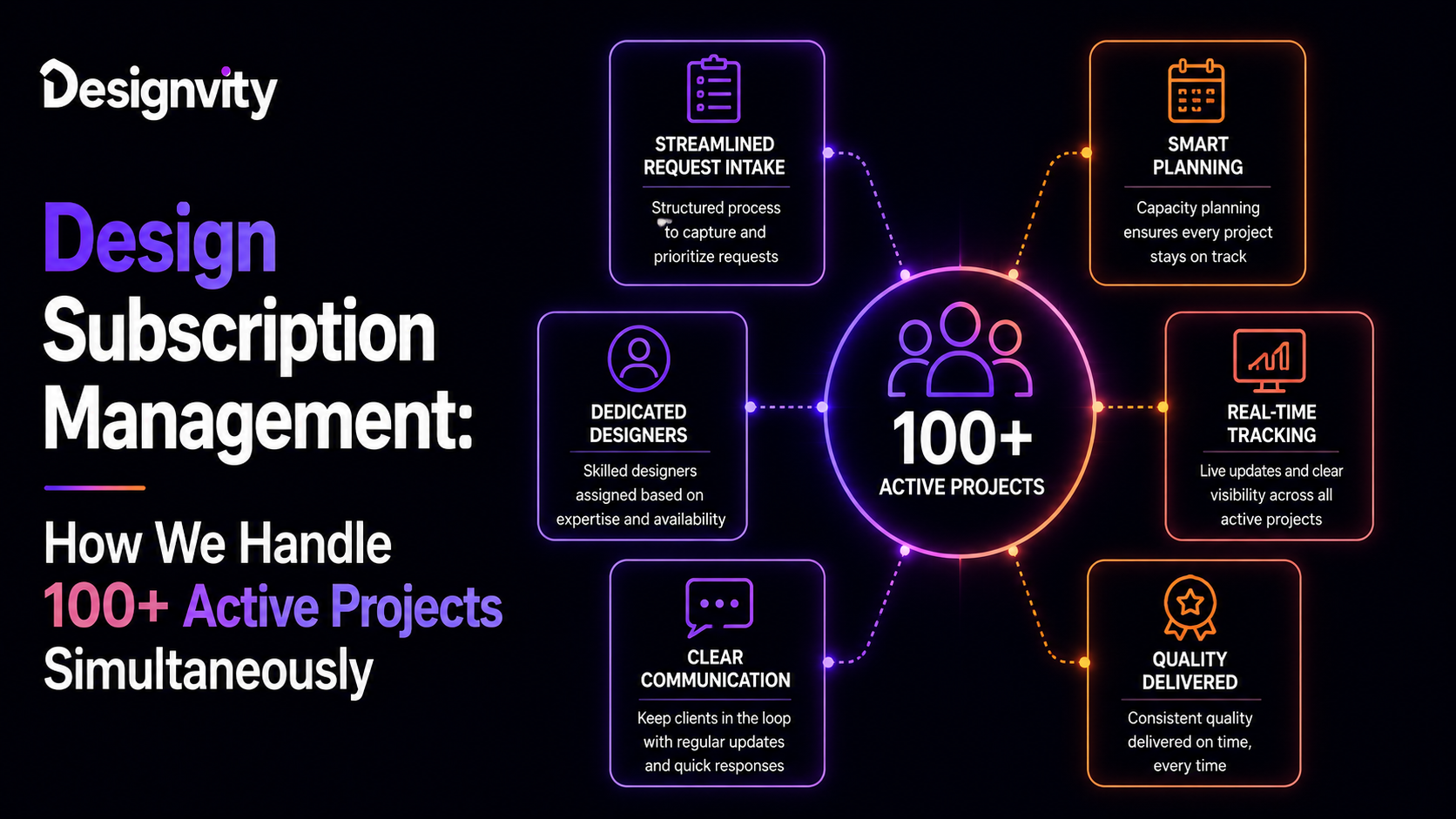
One of the biggest concerns businesses have before signing up for an unlimited graphic design subscription is simple:
“How can one design company manage hundreds of active clients without sacrificing quality or turnaround time?”
It’s a fair question.
Managing a handful of design projects is relatively straightforward. Managing more than 100 active projects—each with different priorities, brands, revision cycles, and deadlines—is a completely different challenge.
At Designvity, we’ve built scalable systems, standardized workflows, and collaborative processes that allow us to deliver high-quality creative work efficiently across multiple clients. Success doesn’t come from working harder—it comes from designing smarter operations.
In this behind-the-scenes guide, we’ll explain the design project management systems, automation strategies, and team workflows that enable us to scale without compromising creativity or client experience.
Why Traditional Agency Operations Break at Scale
Many agencies grow by simply adding more designers as new clients come in.
Initially, this works.
But over time, common challenges begin to appear:
- Missed deadlines
- Poor communication
- Lost revision requests
- Uneven workload distribution
- Designer burnout
- Inconsistent quality
- Delayed approvals
Without standardized processes, increasing project volume often creates operational bottlenecks.
Scaling successfully requires systems—not just more people.
Our Philosophy: Build Systems, Not Chaos
Every project follows a defined workflow.
Instead of relying on memory or manual coordination, we use repeatable processes that keep every request organized from submission to delivery.
Our focus is on:
- Process consistency
- Clear communication
- Transparent workflows
- Quality assurance
- Continuous improvement
This operational foundation allows our team to support a growing client base while maintaining predictable turnaround times.
Step 1: Centralized Project Intake
Every design request enters a structured intake system.
Clients provide:
- Project details
- Objectives
- Brand assets
- Reference materials
- Priority level
- Required dimensions
- Delivery expectations
Standardized briefs reduce unnecessary back-and-forth and help designers begin work with complete information.
Step 2: Smart Project Prioritization
Not every project carries the same urgency.
Requests are organized based on factors such as:
- Business impact
- Deadline
- Complexity
- Revision status
- Resource availability
This ensures that high-priority work receives immediate attention while maintaining fairness across all active clients.
Step 3: Dedicated Creative Pods
Rather than assigning projects randomly, we organize our team into specialized creative pods.
Each pod may include:
- Graphic Designers
- UI/UX Designers
- Brand Specialists
- Motion Designers
- Quality Reviewers
This structure improves familiarity with client brands and reduces onboarding time for recurring projects.
Step 4: Creative Workflow Automation
Managing hundreds of projects manually isn’t sustainable.
Our creative workflow automation reduces repetitive administrative tasks by automating:
- Task assignments
- Status updates
- Notifications
- Approval workflows
- Deadline reminders
- File organization
- Internal checklists
Automation allows designers to spend more time designing and less time managing logistics.
Step 5: Standardized Design Systems
Many clients require ongoing creative work across multiple channels.
Instead of redesigning common elements repeatedly, we build reusable design systems that include:
- Brand colors
- Typography
- Logo usage
- Icon libraries
- Social templates
- Presentation layouts
- UI components
- Marketing assets
This improves both speed and consistency.
Step 6: Multi-Project Design Coordination
Handling over 100 active projects requires careful resource planning.
Our multi-project design coordination strategy focuses on:
Workload Balancing
Projects are distributed according to:
- Designer expertise
- Current capacity
- Project complexity
- Delivery timeline
Balanced workloads reduce burnout and improve quality.
Cross-Team Collaboration
Designers, reviewers, and project coordinators communicate continuously throughout each project lifecycle.
This minimizes delays and accelerates approvals.
Real-Time Project Visibility
Every project has clearly defined stages, allowing the entire team to track progress without unnecessary meetings or status requests.
Step 7: Multi-Level Quality Assurance
Every design passes through multiple review stages before delivery.
Quality checks include:
- Brand consistency
- Typography
- Alignment
- Spacing
- Visual hierarchy
- Technical specifications
- File formatting
- Client requirements
This review process reduces revisions and maintains consistent design standards.
Step 8: Revision Management
Unlimited revisions don’t mean unlimited confusion.
Revision requests are:
- Logged systematically
- Prioritized
- Assigned immediately
- Reviewed for completeness
Version control ensures every update remains organized throughout the project.
Step 9: Performance Tracking
Operational excellence depends on measurement.
We continuously monitor metrics such as:
- Average turnaround time
- Revision frequency
- Client satisfaction
- Team utilization
- Delivery consistency
- Project completion rates
These insights help us optimize workflows as our client base grows.
Technology That Supports Scale
While people remain at the center of creativity, technology helps us operate efficiently.
Our workflow includes tools for:
- Project management
- Team communication
- File collaboration
- Design systems
- Version control
- Documentation
- Performance reporting
The goal isn’t to replace creativity—it’s to remove operational friction.
Why Process Matters More Than Team Size
Many agencies believe scaling means hiring more designers.
In reality, poorly organized teams become less efficient as they grow.
Well-designed systems allow smaller, focused teams to outperform much larger organizations by eliminating unnecessary complexity.
Efficient processes create:
- Faster delivery
- Better communication
- Higher quality
- Improved client satisfaction
- Greater profitability
Common Mistakes Agencies Make
As creative teams expand, these operational mistakes become increasingly common:
No Standardized Briefs
Incomplete project information leads to delays and revisions.
Manual Task Management
Tracking projects through emails or spreadsheets quickly becomes unmanageable.
Inconsistent Review Processes
Without quality checkpoints, mistakes reach clients more frequently.
Poor Resource Planning
Uneven workloads create bottlenecks while other team members remain underutilized.
Limited Process Documentation
Scaling becomes difficult when workflows exist only in people’s heads.
Why Unlimited Design Works with the Right Systems
Unlimited design subscriptions are only successful when supported by efficient operations.
Strong systems allow agencies to:
- Handle high request volumes
- Maintain predictable turnaround times
- Preserve design quality
- Improve collaboration
- Deliver consistent client experiences
Without operational discipline, unlimited services quickly become unsustainable.
How Designvity Delivers Scalable Creative Support
At Designvity, our subscription model is built around structured operations, experienced designers, and continuous process improvement.
Our services include:
- Unlimited Graphic Design
- Unlimited Revisions
- Dedicated Designers
- UI/UX Design
- Branding & Identity
- Social Media Design
- Presentation Design
- Landing Page Design
- Motion Graphics
- White Label Design Services
Every project follows proven workflows designed to maximize efficiency while ensuring every client receives the attention and quality they expect.
People Also Search For
- design project management systems
- creative workflow automation
- multi-project design coordination
- unlimited graphic design workflow
- creative operations management
- design subscription process
- agency project management
- design team workflow
- scalable creative services
- design operations best practices
People Also Ask
How do unlimited design agencies manage so many projects?
Successful agencies use standardized workflows, project management systems, automation, dedicated teams, and quality assurance processes to coordinate hundreds of active projects efficiently.
What is creative workflow automation?
Creative workflow automation uses software to automate repetitive operational tasks such as project assignments, notifications, approvals, and status tracking, allowing designers to focus on creative work.
How does Designvity maintain quality with multiple projects?
Designvity follows structured design systems, multi-level quality reviews, standardized briefs, and dedicated creative teams to ensure consistency across every client project.
Can unlimited design subscriptions really scale?
Yes. With the right operational systems, resource planning, and workflow automation, agencies can successfully support a large number of active clients while maintaining fast turnaround times and high-quality deliverables.
Why choose Designvity?
Designvity combines experienced designers with scalable project management systems, enabling businesses to access reliable, high-quality creative support through a streamlined unlimited design subscription model.
Frequently Asked Questions
Does managing more projects reduce design quality?
Not when supported by standardized workflows, dedicated designers, and structured quality assurance. Efficient systems allow teams to scale without compromising creative standards.
How quickly are design requests assigned?
Requests are reviewed through a centralized intake process and prioritized based on urgency, complexity, and available resources to ensure efficient allocation.
How are revisions managed across multiple clients?
Every revision is tracked through a structured workflow with version control, ensuring requests remain organized and are completed accurately.
What makes Designvity’s workflow different?
Designvity emphasizes process-driven operations, combining automation, reusable design systems, specialized creative teams, and continuous performance monitoring to deliver consistent results at scale.
Why partner with Designvity?
Designvity offers more than unlimited graphic design—it provides a scalable creative operations framework. By combining experienced professionals with proven project management systems and workflow automation, we help businesses and agencies receive reliable, high-quality design support without the complexity of building and managing a large in-house team.
Conclusion
Managing more than 100 active design projects isn’t about working faster—it’s about working smarter. Structured design project management systems, intelligent automation, standardized workflows, and dedicated creative teams make it possible to deliver high-quality work consistently, even at scale.
At Designvity, every process is designed to eliminate bottlenecks, improve collaboration, and ensure clients receive dependable creative support as their businesses grow. Whether you need ongoing marketing assets, UI/UX design, branding, or white-label creative services, our operational model is built to scale with you.