

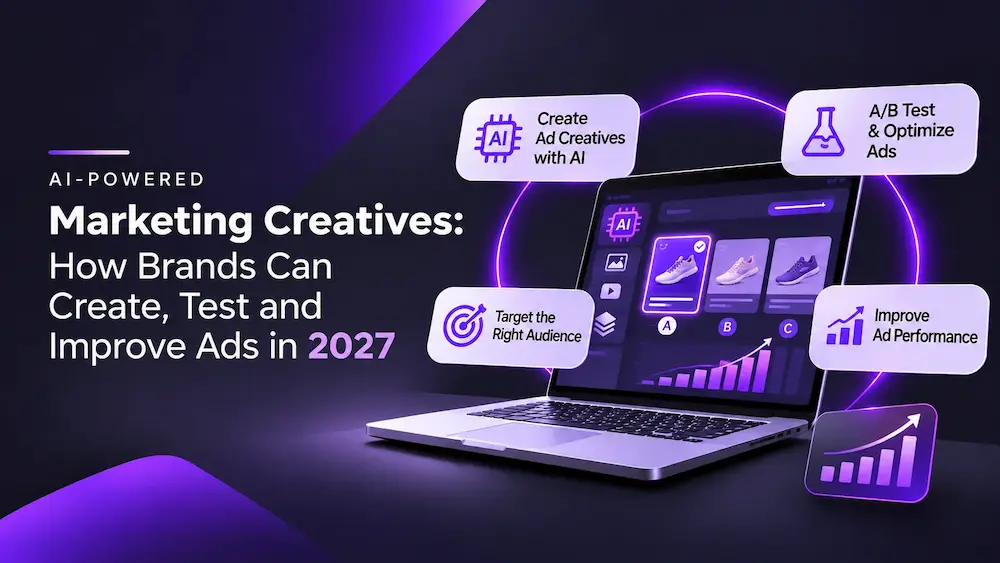
AI-powered marketing creatives combine artificial intelligence with human creative expertise to develop advertising visuals, campaign concepts, copy and video assets. AI tools can help marketers explore ideas, create variations and adapt content for different channels, while designers ensure the finished work remains accurate, recognizable and aligned with the brand.
For businesses managing frequent campaigns, the challenge is no longer simply creating more advertisements. It is producing relevant creative assets that communicate a clear message and contribute to measurable results.
At Designvity, AI-assisted workflows complement professional graphic design, branding, motion graphics and marketing creative support.
This guide explains how AI advertising creatives work, where human expertise remains important and how to build a practical creative production process.
What Are AI-Powered Marketing Creatives?
AI-powered marketing creatives are advertising assets developed or refined using artificial intelligence.
They can include social media advertisements, display banners, product visuals, marketing videos, advertising copy, email graphics and campaign variations.
For example, an ecommerce company launching a new skincare collection might need separate visual concepts for Instagram, Facebook, Google Ads and its website.
AI can support concept generation and adaptation, but the company still needs to verify product details, claims, branding and the final design.
This combination of intelligent tools and creative oversight is particularly useful for businesses managing several campaigns simultaneously.
What Can AI Do in Marketing Creative Production?
AI is useful across multiple stages of the creative process.
| Creative task | Potential AI assistance | Human responsibility |
| Campaign concepts | Generate ideas and visual directions | Select strategic concepts |
| Advertising copy | Draft headlines and variations | Verify accuracy and brand voice |
| Product visuals | Explore compositions and backgrounds | Confirm product representation |
| Social media design | Adapt layouts and formats | Review visual quality |
| Video production | Assist with storyboards and editing | Control storytelling and final output |
| Localization | Draft language variations | Check cultural and linguistic accuracy |
| Creative testing | Organize performance information | Interpret results and make decisions |
An AI-generated design should be treated as a creative starting point, not automatically as an approved advertisement.
How to Build an AI-Powered Advertising Creative Workflow
A reliable process connects campaign planning, creative production and performance analysis.
Step 1: Define the Campaign Objective
Start by identifying what the advertisement should accomplish.
Are you trying to generate qualified leads, increase product purchases, promote a new service or improve awareness?
A campaign without a clear objective can produce attractive visuals that do little to support the business.
Step 2: Prepare a Detailed Creative Brief
Include the target audience, product details, brand guidelines, approved claims, campaign message, preferred formats and intended advertising channels.
Specify any visual elements that must remain unchanged.
For example, a product’s packaging, logo and dimensions should not be altered merely because an AI-generated variation looks appealing.
Step 3: Explore Creative Directions
AI can assist with brainstorming different campaign approaches.
One concept might emphasize convenience, another product quality and a third a practical customer problem.
A human creative director should assess which direction best fits the intended audience and brand positioning.
Step 4: Develop and Refine Assets
Designers can combine generated concepts with professional typography, layouts, image editing, motion design and brand systems.
Designvity discusses this hybrid approach in its article on AI design tools and the role of human designers.
Step 5: Review Before Publication
Check product accuracy, spelling, accessibility, licensing, brand consistency and advertising policies.
The review stage should be documented, particularly for regulated industries or advertisements containing measurable product claims.
Step 6: Test and Improve
Publish approved variations through an appropriate testing plan.
Evaluate performance and use the findings to guide the next creative brief.
AI Ad Creatives vs Traditional Graphic Design
AI-assisted and traditional design workflows have different strengths.
| Factor | AI-assisted creative workflow | Traditional design workflow |
| Initial ideation | Can produce many draft directions quickly | Relies on designer-led exploration |
| Brand consistency | Requires controlled inputs and review | Guided by established brand systems |
| Repetitive variations | Useful for adaptation and resizing | May require more manual production |
| Original campaign strategy | Still requires human judgment | Typically human-led |
| Complex brand storytelling | Requires editorial and creative refinement | Stronger direct creative control |
| Final quality assurance | Human review remains necessary | Human review remains necessary |
The strongest approach is often a combination of both.
AI can assist with repetitive production tasks while experienced designers retain responsibility for visual communication, originality and the customer experience.
How to Test AI Advertising Creatives Without Wasting Budget
Creating 30 advertisement variations is not automatically more valuable than creating three well-researched concepts.
Effective creative testing begins with a question.
For example, an online retailer may want to know whether product-focused visuals outperform lifestyle-focused visuals for a particular audience.
A useful experiment could compare:
- Product close-up against lifestyle photography
- Benefit-led headline against feature-led headline
- Different calls to action
- Static creative against short-form video
Where possible, keep other major campaign variables consistent so the results are easier to interpret.
Measure outcomes such as click-through rate, cost per qualified lead, conversion rate and return on advertising spend.
Designvity’s design A/B testing guide explains how structured experimentation helps teams evaluate design decisions.
Testing needs sufficient data. A creative should not be declared the winner simply because it received a handful of clicks.
Where Can Businesses Use AI-Powered Graphic Design?
Ecommerce Advertising
Online stores can explore product backgrounds, promotional layouts, category banners and campaign variations.
Social Media Campaigns
Marketing teams can develop platform-specific graphics, carousel concepts, reels and short-form visual assets.
B2B Lead Generation
Professional services and SaaS companies may use AI-assisted creative production for reports, webinar promotions, LinkedIn advertisements and downloadable resources.
Video Advertising
AI can support scripting, visual concepts, editing and selected production tasks.
However, final video quality still depends on storytelling, pacing, factual accuracy and production review.
Website and Landing Page Design
Campaign visuals can also inform landing page layouts, hero sections and promotional graphics.
This is where an AI design and development agency may offer broader value by connecting creative production with website implementation.
Why Human Review Still Matters in AI Advertising
AI-generated marketing content can contain inaccurate text, unrealistic product details, inconsistent branding or misleading visual representations.
These mistakes may damage customer confidence or create advertising compliance problems.
Before publishing, marketing teams should review:
- Product specifications and factual claims
- Copyright, licensing and usage permissions
- Brand logos, fonts and visual guidelines
- Representation of people and products
- Platform advertising requirements
- AI-related disclosure obligations where applicable
The Interactive Advertising Bureau’s generative AI advertising playbook provides additional guidance on applying generative AI within advertising workflows.
Professional creative oversight is not simply a final spelling check. It is part of producing trustworthy marketing materials.
How to Choose an AI Advertising Creative Agency
When comparing an AI advertising creative agency with a self-service AI tool, consider the level of creative direction and support your business requires.
A tool may be sufficient for early concept exploration.
An agency or professional design studio may be more suitable when you need coordinated campaigns, established brand standards, editable files, video production or ongoing creative support.
Ask prospective partners:
- Who develops the creative strategy?
- Which activities use AI assistance?
- How are final designs reviewed?
- What source files and usage rights are included?
- How are revisions handled?
- Can the team support multiple advertising formats?
- Who is responsible for testing and performance reporting?
These questions help reveal what the service actually includes.
An Example: Planning a Creative Campaign for an Ecommerce Brand
Consider a hypothetical ecommerce business launching a new product category.
The team could begin with three creative directions: product benefits, customer problems and lifestyle applications.
Each direction could then be adapted into two visual formats.
That creates six candidate creatives for review.
After checking the assets and obtaining approval, the business could test the variations through its advertising platform.
Performance data would help inform subsequent design decisions.
This is an illustrative workflow, not a claimed client case study or guaranteed advertising result.
The advantage is that creative work becomes a repeatable learning process rather than an endless cycle of producing new graphics.
How Designvity Supports AI-Assisted Marketing Creatives
Designvity combines professional design services with AI-assisted production techniques.
Its published capabilities include graphic design, social media assets, banners, branding, motion graphics, video editing and AI video generation.
The studio also provides ongoing design support through subscription and agency-oriented arrangements.
Businesses evaluating ongoing creative production can review Designvity’s design subscription and agency pricing options.
The right arrangement depends on creative volume, project complexity, turnaround requirements and the degree of human oversight needed.
Designvity’s approach positions AI as support for the creative process rather than a complete replacement for experienced designers.
Frequently Asked Questions
What are AI-powered marketing creatives?
They are advertising visuals, copy, video or related assets created or refined with the assistance of artificial intelligence.
Can AI generate complete advertising campaigns?
AI can help develop concepts and campaign assets, but effective campaigns still require strategic planning, factual review, targeting, budget decisions and performance evaluation.
Are AI-generated advertisements better than human-designed ads?
Not necessarily. Performance varies according to the creative concept, audience, product, execution and testing methodology.
Can small businesses use AI-powered marketing creatives?
Yes. Small businesses can use AI-assisted tools for brainstorming, content adaptation and production support while maintaining appropriate quality checks.
Can an AI advertising creative agency produce video advertisements?
Some agencies offer AI-assisted video development, editing and motion graphics. Confirm the exact production capabilities before engaging a provider.
Does AI-powered graphic design reduce costs?
It can reduce time spent on some repetitive tasks, but overall costs depend on creative complexity, licensing, human review and the number of revisions.
How should brands measure advertising creative performance?
Use campaign objectives and relevant metrics such as qualified leads, conversions, acquisition costs and revenue, rather than relying only on impressions or creative output volume.
Create Better Marketing Campaigns With AI and Human Expertise
The future of AI-powered marketing creatives is not simply about generating more images, advertisements or videos.
It is about combining creative strategy, appropriate automation, professional design and evidence-based improvements.
Businesses that establish this process can create more consistent marketing assets while retaining control of their brand identity.
If your team needs regular graphic design, campaign visuals, social media assets or video production support, Designvity offers flexible creative services.
Book a discovery call with Designvity to discuss your creative requirements and find a suitable production approach.