

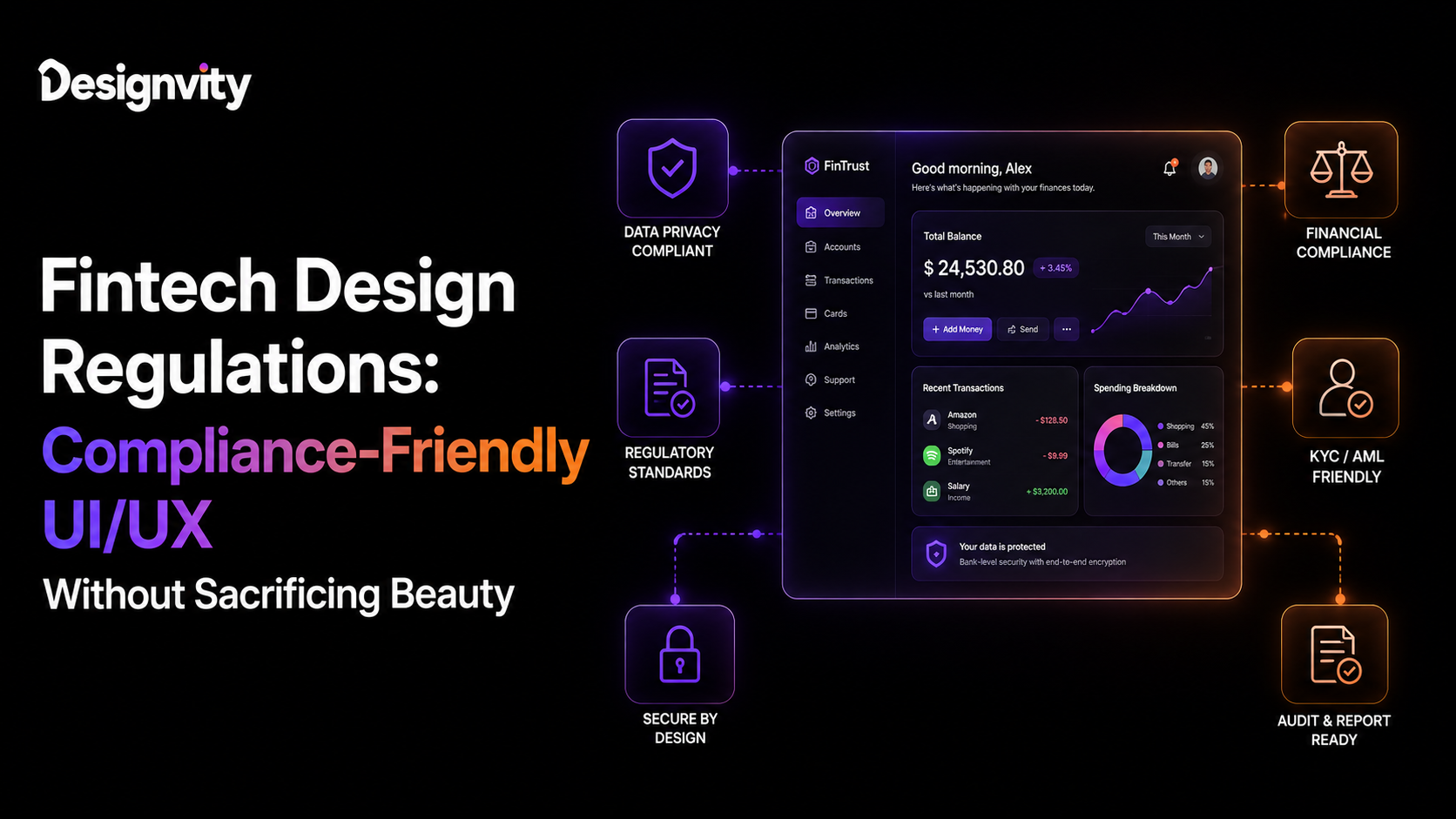
The fintech industry has transformed how people bank, invest, borrow, and manage money. From digital banking apps and payment platforms to cryptocurrency exchanges and wealth management solutions, today’s users expect fast, intuitive, and secure digital experiences.
However, designing for fintech isn’t only about aesthetics. Every interface must also satisfy strict regulatory, security, accessibility, and privacy requirements.
Many startups mistakenly believe that compliance limits creativity. In reality, the best financial products prove that fintech UI/UX compliance and outstanding user experience can work together.
Leading brands like Stripe, Wise, Revolut, and Robinhood demonstrate that trustworthy interfaces can also be modern, engaging, and conversion-focused.
In this guide, we’ll explore how businesses can create compliant, user-friendly financial products while maintaining a premium digital experience.
Why UI/UX Matters More in FinTech
Financial applications handle highly sensitive customer information and transactions.
Users expect:
- Complete transparency
- Strong security
- Easy navigation
- Fast onboarding
- Clear communication
- Accessible interfaces
- Trustworthy experiences
A confusing interface can reduce customer confidence and increase abandonment during onboarding or transactions.
Great UX builds trust before customers ever make their first payment.
What Is Fintech UI/UX Compliance?
Fintech UI/UX compliance means designing digital products that satisfy industry regulations while remaining intuitive and user-friendly.
A compliant financial interface considers:
- Data privacy
- User consent
- Accessibility
- Security
- Identity verification
- Risk disclosures
- Transaction transparency
- Consumer protection
Rather than adding compliance later, successful fintech companies incorporate regulatory requirements into the design process from the beginning.
Why Compliance Should Drive Design Decisions
Financial regulations exist to protect users.
Good design makes compliance feel natural rather than intrusive.
Benefits include:
- Increased customer trust
- Lower legal risk
- Better onboarding completion
- Improved accessibility
- Higher customer retention
- Stronger brand reputation
Compliance becomes a competitive advantage when executed thoughtfully.
Key FinTech Design Regulations to Consider
Although regulations vary across countries, fintech products commonly address:
Data Privacy
Applications should clearly explain:
- Data collection
- User consent
- Cookie preferences
- Information sharing
- Privacy policies
Transparency builds confidence.
Identity Verification (KYC)
Many financial platforms require Know Your Customer (KYC) verification.
Design should simplify document uploads, identity checks, and verification progress while minimizing user frustration.
Anti-Money Laundering (AML)
AML procedures often require additional user information and transaction monitoring.
Well-designed workflows help users understand why these checks are necessary.
Accessibility Standards
Modern financial products should comply with accessibility guidelines, including:
- Screen reader compatibility
- Keyboard navigation
- Color contrast
- Readable typography
- Focus indicators
- Responsive layouts
Accessible products serve more customers while reducing legal risks.
Security & Authentication
Financial products should support:
- Multi-factor authentication
- Biometric login
- Secure password creation
- Session management
- Device verification
Security features should protect users without creating unnecessary friction.
How to Balance Compliance with User Experience
Simplify Complex Processes
Financial regulations often introduce additional steps.
Use:
- Progress indicators
- Step-by-step onboarding
- Clear instructions
- Visual guidance
- Error prevention
Breaking large tasks into smaller steps reduces abandonment.
Write Human-Friendly Compliance Content
Legal language can overwhelm users.
Instead of:
“Pursuant to applicable regulatory obligations…”
Use:
“We verify your identity to keep your account secure and comply with financial regulations.”
Plain language improves understanding.
Use Smart Form Design
Lengthy forms increase drop-off rates.
Best practices include:
- Auto-fill support
- Input validation
- Inline error messages
- Smart defaults
- Mobile-friendly fields
Simple forms improve completion rates.
Make Security Visible
Customers feel more comfortable when they can see security measures.
Include:
- SSL indicators
- Security badges
- Encryption messaging
- Authentication notifications
- Transaction confirmations
Visible security increases trust.
Design for Transparency
Financial products should clearly communicate:
- Fees
- Interest rates
- Payment schedules
- Terms and conditions
- Investment risks
Transparency reduces confusion and strengthens customer relationships.
Essential UI Components for FinTech Apps
Successful compliant user interface design includes:
- Secure login screens
- Account dashboards
- Transaction history
- Spending analytics
- Notifications
- Verification workflows
- Document upload interfaces
- Payment confirmation screens
- Error states
- Customer support access
Every component should prioritize clarity and confidence.
Common FinTech UX Mistakes
Avoid these common issues:
- Hidden fees
- Confusing navigation
- Complex onboarding
- Poor accessibility
- Generic error messages
- Weak authentication flows
- Inconsistent branding
- Slow page loading
- Lack of progress indicators
These problems reduce user trust and increase abandonment.
Designing for Mobile-First Banking
Many users interact with financial products primarily on smartphones.
A mobile-first fintech experience should include:
- Responsive layouts
- Thumb-friendly navigation
- Large touch targets
- Fast loading
- Biometric authentication
- Simplified forms
- Mobile wallet integration
A seamless mobile experience is essential for customer satisfaction.
Examples of Great FinTech UX
Successful financial platforms often share these characteristics:
- Minimalist interfaces
- Clear navigation
- Consistent branding
- Transparent pricing
- Guided onboarding
- Personalized dashboards
- Simple financial insights
- Accessible design
Rather than overwhelming users with information, they focus on clarity and confidence.
Best Practices for FinTech UI/UX Compliance
To create compliant financial experiences:
- Involve compliance teams early.
- Prioritize accessibility.
- Test with real users.
- Use consistent visual design.
- Protect customer data.
- Simplify verification workflows.
- Communicate clearly.
- Monitor regulatory updates.
- Continuously optimize user journeys.
Compliance should support—not hinder—the user experience.
Future Trends in FinTech Design
The next generation of financial products will increasingly include:
- AI-powered financial assistants
- Personalized dashboards
- Biometric authentication
- Embedded finance experiences
- Open Banking integrations
- Voice-enabled banking
- Predictive financial insights
- Real-time fraud detection
- Hyper-personalized investment experiences
Designers who embrace these trends while maintaining compliance will build stronger customer relationships.
Why Choose DesignVity?
At DesignVity, we help fintech startups, financial institutions, and SaaS companies create secure, scalable, and conversion-focused digital experiences.
Our expertise includes:
- FinTech UI/UX Design
- Web & Mobile App Design
- Product Design
- Design Systems
- Website Development
- React Development
- WordPress Development
- Branding
- Motion Graphics
- Unlimited Creative Design Services
Our design approach balances compliance, usability, and modern aesthetics to help financial businesses build trust while accelerating growth.
People Also Search For
- FinTech UI design
- Banking app UX best practices
- Financial app design regulations
- FinTech website design
- Digital banking UI inspiration
- Compliant user interface design
- Mobile banking UX
- FinTech product design
- Financial dashboard design
- FinTech UX trends 2026
People Also Ask
What is fintech UI/UX compliance?
Fintech UI/UX compliance refers to designing financial applications that meet legal, security, accessibility, and privacy requirements while delivering an intuitive user experience.
Why is compliance important in fintech design?
Compliance protects customer data, ensures regulatory adherence, builds trust, and reduces legal and operational risks.
Can fintech apps be both compliant and user-friendly?
Yes. The best fintech products integrate compliance seamlessly through clear communication, intuitive workflows, and thoughtful interface design.
What accessibility standards should fintech apps follow?
Financial products should follow recognized accessibility practices, including sufficient color contrast, keyboard navigation, screen reader compatibility, readable typography, and responsive layouts.
What are the biggest UX challenges in fintech?
Common challenges include balancing security with convenience, simplifying complex onboarding processes, presenting financial information clearly, and maintaining user trust throughout the customer journey.
FAQ’s
How can fintech startups improve onboarding conversions?
Simplify KYC flows, reduce unnecessary form fields, provide progress indicators, and explain why information is being requested.
Should fintech products prioritize mobile design?
Absolutely. Most users access banking, payments, and investment services through smartphones, making mobile-first UX essential.
How often should fintech products undergo UX testing?
Regular usability testing helps identify friction points, improve accessibility, and ensure evolving compliance requirements are reflected in the user experience.
Does good UI design improve customer trust?
Yes. Professional, consistent, and transparent interfaces create confidence, making users more likely to complete onboarding and continue using financial products.
Why work with a specialized fintech design agency?
Experienced fintech designers understand how to balance branding, compliance, accessibility, security, and conversion optimization—resulting in products that satisfy both users and regulators.
Conclusion
Designing financial products is about far more than creating attractive screens. Successful fintech UI/UX compliance combines regulatory requirements, accessibility, security, and intuitive design to create experiences that customers trust. By embracing financial app design regulations and implementing compliant user interface design principles from the beginning, businesses can reduce risk, improve onboarding, and strengthen long-term customer relationships.
Whether you’re launching a digital bank, payment platform, lending solution, or investment app, thoughtful design can become a powerful competitive advantage. At DesignVity, we help fintech companies build secure, user-centric digital experiences that meet compliance requirements while delivering exceptional usability and measurable business results.