

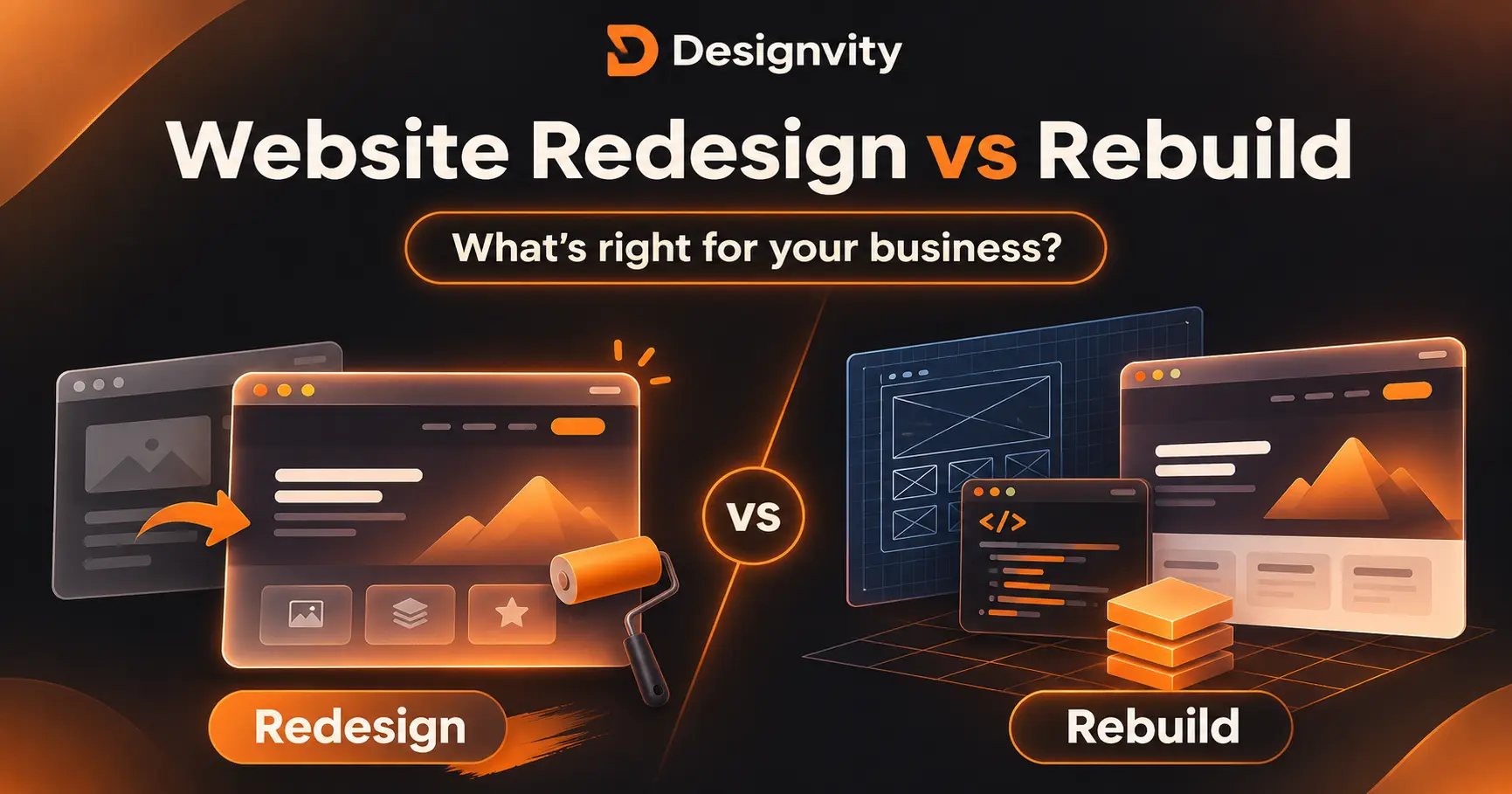
Website redesign services improve an existing website’s appearance, usability, performance, and conversion experience. A complete website rebuild goes further, replacing significant parts of its underlying technology, structure, or functionality.
The best option depends on your website’s condition, business objectives, and technical limitations.
A business with outdated visuals may need only a redesign. But a website with an inflexible CMS, unreliable integrations, or difficult-to-maintain code may require a complete rebuild.
Here’s how to make that decision without creating unnecessary costs or SEO problems.
Website Redesign vs Rebuild: What’s the Difference?
A redesign typically focuses on improving the existing website experience. It may include navigation, layouts, branding, mobile responsiveness, and content presentation.
A rebuild changes the website’s technical foundations. This could involve replacing the CMS, rebuilding templates, changing the application architecture, or developing new functionality.
| Factor | Website Redesign | Website Rebuild |
| Main objective | Improve existing experience | Replace technical foundations |
| CMS | Usually retained | May be replaced |
| Design | Updated | Reimagined |
| Development effort | Often lower | Often higher |
| SEO risks | Manageable with planning | Greater if URLs or content change |
| Best for | Functional but outdated sites | Technically restricted websites |
Neither approach automatically improves Google rankings or sales.
The goal is to solve identified problems while preserving what already works.
Five Signs Your Website Needs a Redesign
1. Your Website Looks Outdated
Inconsistent typography, overcrowded layouts, and unclear messaging can weaken how visitors perceive your business.
Professional web design services can modernize the visual experience without necessarily changing the underlying technology.
2. Mobile Navigation Is Difficult
Check whether visitors can read content, open menus, complete forms, and use important buttons comfortably on smaller screens.
3. Visitors Aren’t Converting
If people visit your website but rarely enquire or purchase, investigate your calls to action, navigation, messaging, and form experience.
Designvity’s UI/UX design services cover user flows, wireframes, prototyping, interface design, and usability evaluation.
4. Brand Messaging Has Changed
A company entering new markets or introducing new services may need updated pages and visual positioning.
5. Pages Are Difficult to Understand
Complex navigation and unclear service descriptions can prevent visitors from finding relevant information.
A redesign should simplify the customer journey, not merely introduce animations.
When Should You Rebuild Your Website?
A complete rebuild becomes more reasonable when visual changes cannot resolve underlying technical limitations.
Consider a rebuild when:
- Your CMS prevents essential functionality.
- Legacy code is expensive to maintain.
- Important third-party integrations are unreliable.
- Security problems require significant architectural changes.
- The website cannot support planned business expansion.
For example, an online retailer might outgrow a heavily customized store that frequently breaks during updates.
Moving to a better-supported e-commerce architecture could make sense, provided the business evaluates migration complexity, integrations, and total ownership costs.
How to Redesign Without Losing SEO
Website redesign services should include an SEO preservation plan whenever content, URLs, navigation, or technical infrastructure changes.
Before launch:
- Export important existing URLs.
- Record organic traffic and conversion benchmarks.
- Preserve valuable content and search intent.
- Map changed URLs to appropriate destinations.
- Implement permanent redirects where necessary.
- Test canonical tags, internal links, and indexing rules.
- Validate mobile usability and page functionality.
Google recommends URL mapping, redirects, testing, and post-migration monitoring for site moves.
A redesign does not always require changing URLs. Preserving stable, useful URLs can reduce unnecessary migration complexity.
Can AI-Powered Web Design Replace Traditional Agencies?
AI-powered web design services can help teams generate layout concepts, draft content, explore design variations, and accelerate repetitive production tasks.
However, generated designs still require human evaluation.
AI tools cannot independently verify a company’s positioning, accurately understand every customer journey, or guarantee accessibility and conversions.
For example, AI might generate an attractive landing page, but a designer must still evaluate whether its message, navigation, and forms match actual customer needs.
The stronger approach combines AI-assisted experimentation with experienced designers, developers, and real-user feedback.
How to Choose a Website Development Agency
Before hiring a website development agency, compare its ability to deliver measurable business improvements.
Ask these questions:
- Will the team audit the existing website before proposing changes?
- Can it demonstrate relevant technical experience?
- Who owns the design files and source code?
- How will SEO and existing URLs be protected?
- What testing happens before launch?
- Is ongoing support available?
Avoid selecting an agency based exclusively on attractive portfolio screenshots.
Review functionality, maintainability, communication, and documented project outcomes.
Measure Results After Your Website Launch
A successful redesign should improve more than appearance.
Track:
- Qualified leads and enquiries
- Form completion rates
- E-commerce conversions
- Organic search traffic
- Mobile usability
- Core Web Vitals
- Customer feedback
For conversion experiments, Designvity’s design A/B testing guide explains how businesses can compare design variations and measure outcomes.
Record benchmarks before making major changes so results can be evaluated fairly.
How Designvity Supports Web Design and Development
Designvity offers subscription-based and flexible hourly design and development support for businesses, founders, and agencies.
Its published capabilities include WordPress, Elementor, Shopify, React, Next.js, UI/UX design, and landing page development.
Businesses considering a website redesign or rebuild can discuss their requirements with Designvity to determine an appropriate project scope and support model.
Frequently Asked Questions
Is redesigning a website cheaper than rebuilding it?
Often, but not always. Cost depends on existing code quality, functionality, integrations, content changes, and testing requirements.
Will redesigning my website affect SEO?
It can. URL changes, removed content, broken internal links, and indexing mistakes may affect organic visibility. A properly planned redesign reduces avoidable risks.
Can AI create a complete professional website?
AI tools can assist with design and development, but professional evaluation is still important for security, accessibility, functionality, branding, and quality assurance.
How often should a business redesign its website?
There is no universal schedule. Redesign when user research, performance data, brand changes, or technical limitations demonstrate a genuine need.
Final Thoughts
Choosing between a redesign and a rebuild should begin with a business and technical audit—not a preference for newer visuals or technology.
Preserve what works, address what doesn’t, and select a development approach that supports measurable business goals.
A successful website should be easy to use, maintain, discover, and convert visitors into customers.