

Great design isn’t based on opinions—it’s based on data.
A landing page that looks visually impressive doesn’t necessarily generate more leads. Likewise, a beautifully designed call-to-action (CTA) button won’t always improve conversions. The only reliable way to know what truly works is through A/B testing.
For modern businesses, design decisions should be driven by user behavior rather than assumptions. By following a structured design A/B testing guide, companies can continuously optimize websites, landing pages, marketing campaigns, and product experiences to improve conversion rates and maximize return on investment.
In this guide, you’ll learn what elements to test, how to build a repeatable design experiment framework, which metrics matter most, and the tools that help teams make confident, data-backed design decisions.
What Is Design A/B Testing?
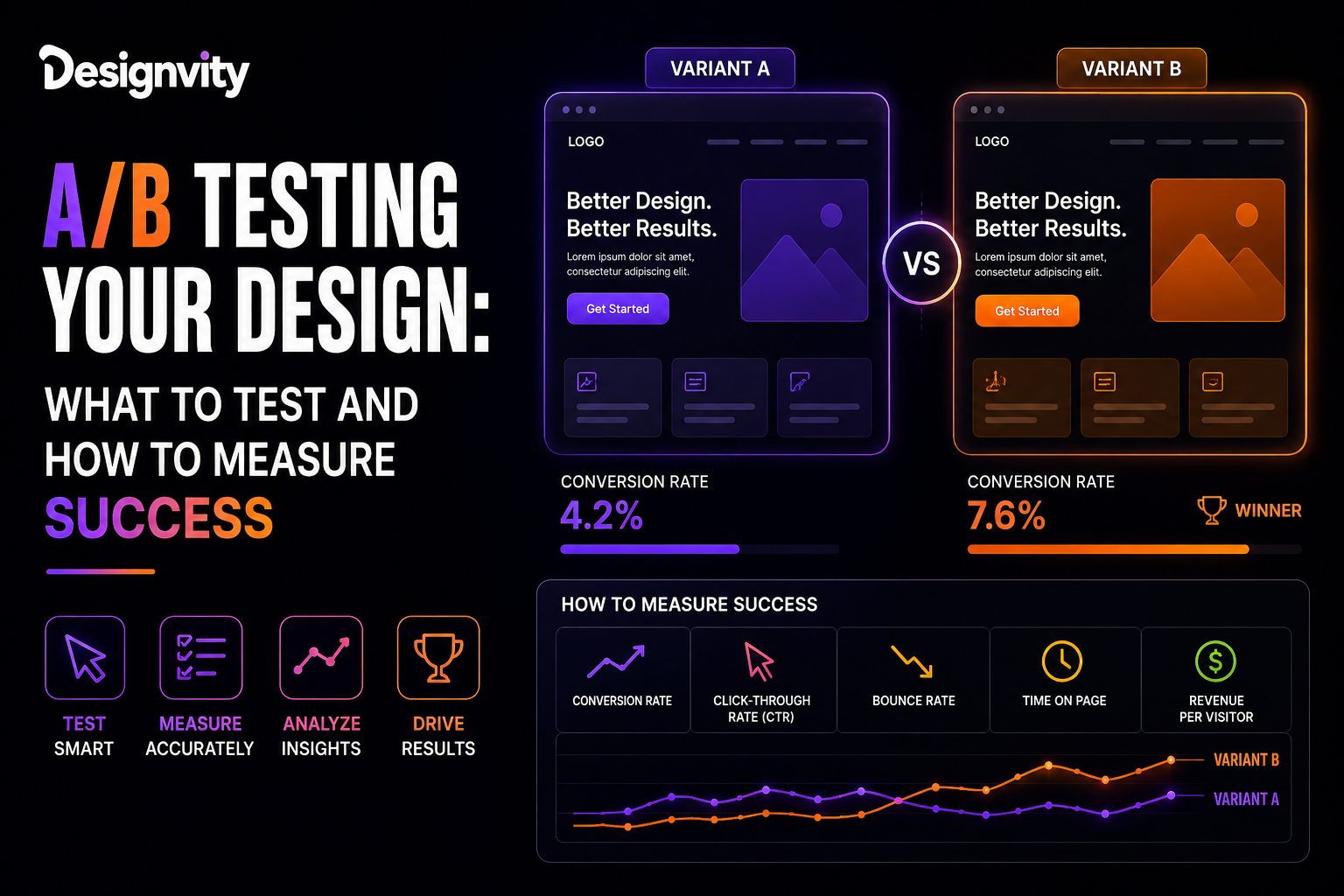
Design A/B testing is the process of comparing two versions of a design to determine which one performs better based on a specific business goal.
Typically:
- Version A is the current design (Control).
- Version B is the modified design (Variant).
Traffic is split between both versions, and user behavior is measured to identify which design produces better results.
Unlike subjective design reviews, A/B testing provides measurable evidence for design improvements.
Why A/B Testing Matters
Even small design changes can have a significant impact on user behavior.
Testing allows businesses to:
- Increase conversion rates
- Improve user experience
- Reduce bounce rates
- Increase revenue
- Improve lead generation
- Reduce guesswork
- Validate design decisions
Rather than redesigning an entire website, companies can make incremental improvements backed by real data.
When Should You Run A/B Tests?
A/B testing is valuable whenever a page influences business outcomes.
Common use cases include:
- Landing pages
- Homepage layouts
- Product pages
- Pricing pages
- Checkout flows
- Contact forms
- Email campaigns
- Ad creatives
- Mobile app interfaces
If a page affects conversions, it’s worth testing.
What Design Elements Should You Test?
1. Headlines
Your headline is often the first thing visitors notice.
Test:
- Length
- Value proposition
- Tone of voice
- Benefit-focused messaging
- Question vs statement
Even subtle wording changes can improve engagement.
2. Call-to-Action (CTA) Buttons
CTA buttons are among the highest-impact design elements.
Experiment with:
- Button text
- Button size
- Placement
- Shape
- Color contrast
- White space
- Primary vs secondary CTAs
Focus on clarity rather than flashy design.
3. Hero Sections
Your hero section determines the first impression.
Test:
- Headlines
- Images
- Illustrations
- Videos
- Layout variations
- CTA placement
A stronger hero section often improves engagement across the entire page.
4. Forms
Long forms frequently reduce conversions.
Test:
- Number of fields
- Multi-step forms
- Button labels
- Field order
- Optional vs required fields
Reducing friction often leads to higher completion rates.
5. Navigation
Simpler navigation can improve usability.
Consider testing:
- Menu structure
- Sticky navigation
- Dropdown behavior
- Search placement
- Mobile navigation
The easier it is for users to find information, the more likely they are to convert.
6. Product Images
For eCommerce businesses, visuals strongly influence purchasing decisions.
Experiment with:
- Lifestyle photography
- Product-only images
- Zoom functionality
- Image galleries
- 360-degree views
- Video demonstrations
Visual clarity builds confidence.
7. Pricing Pages
Pricing pages are ideal candidates for A/B testing.
Test:
- Plan layouts
- Pricing tables
- Highlighted plans
- Feature comparisons
- Guarantee messaging
- Trust badges
Small adjustments can significantly improve conversion rates.
8. Testimonials and Social Proof
Trust is a major conversion factor.
Test:
- Customer reviews
- Video testimonials
- Company logos
- Star ratings
- Success stories
- Case studies
Showing credibility at the right moment often increases user confidence.
Build a Simple Design Experiment Framework
Running random tests often leads to confusing results. Instead, follow a structured process:
Step 1: Identify the Goal
Examples include:
- Increase sign-ups
- Generate more demo requests
- Improve checkout completion
- Reduce bounce rate
Define one measurable objective before starting.
Step 2: Form a Hypothesis
A good hypothesis follows this format:
“If we change X, then Y will improve because Z.”
Example:
“If we simplify the pricing page layout, more visitors will start a free trial because the plans will be easier to compare.”
Step 3: Test One Variable at a Time
Avoid changing multiple elements simultaneously.
For example:
✅ Button text only
❌ Button text, color, layout, headline, and images together
Testing one variable makes results easier to interpret.
Step 4: Collect Enough Data
Don’t stop a test too early.
Allow enough traffic and time to reach statistically meaningful results. Decisions based on small sample sizes can be misleading.
Step 5: Analyze Results
Review performance against your original goal.
If the variation performs better, implement it. If not, document what you learned and test another hypothesis.
Continuous improvement is the objective.
Metrics That Matter
Successful conversion rate optimization testing focuses on business outcomes rather than vanity metrics.
Track metrics such as:
- Conversion rate
- Click-through rate (CTR)
- Bounce rate
- Form completion rate
- Average session duration
- Scroll depth
- Revenue per visitor
- Average order value
- Lead generation rate
Choose metrics that align with your business goals.
Best Tools for A/B Testing
Popular tools include:
- Google Analytics 4
- Microsoft Clarity
- Hotjar
- VWO
- Optimizely
- Convert
- AB Tasty
- Crazy Egg
Many of these tools combine analytics, heatmaps, recordings, and experimentation to provide deeper insights into user behavior.
Common A/B Testing Mistakes
Avoid these common pitfalls:
- Testing too many changes at once
- Ending experiments too early
- Ignoring mobile users
- Chasing vanity metrics
- Running tests without clear hypotheses
- Making decisions based on opinions rather than data
- Failing to document learnings
Successful experimentation is disciplined and repeatable.
Best Practices for Ongoing Optimization
Design optimization isn’t a one-time project.
Build a culture of continuous testing by:
- Prioritizing high-impact pages
- Creating a testing roadmap
- Documenting every experiment
- Sharing insights across teams
- Revisiting successful tests over time
- Combining quantitative and qualitative research
Small improvements compound into significant business growth.
Why Unlimited Design Services Make A/B Testing Easier
Frequent experimentation requires a steady stream of design variations.
Creating multiple landing pages, ad creatives, email designs, or pricing page layouts can quickly overwhelm in-house teams or become expensive when working with freelancers.
With an unlimited design subscription, businesses can request as many design variations as needed, making continuous optimization faster and more cost-effective.
Why Choose Designvity?
At Designvity, we help businesses move beyond one-off design projects by providing an Unlimited Graphic Design Subscription that supports continuous growth and experimentation.
Our services include:
- Landing page design
- Website UI/UX design
- Conversion-focused design
- Marketing creatives
- Social media graphics
- Presentation design
- Motion graphics
- White-label design support
- Branding and visual identity
- Unlimited design revisions
Whether you’re testing landing pages, improving ad creatives, or optimizing product pages, our dedicated design team helps you create high-quality design variations quickly—without the delays and costs of hiring additional designers. This enables marketing teams to run more experiments, learn faster, and improve conversion rates consistently.
People Also Search For
- design A/B testing guide
- conversion rate optimization testing
- design experiment framework
- landing page A/B testing
- website conversion optimization
- UI/UX testing
- CTA optimization
- website design testing
- CRO design strategy
- unlimited graphic design service
People Also Ask
What is design A/B testing?
Design A/B testing compares two versions of a design to determine which performs better based on measurable goals such as conversions, clicks, or sign-ups.
What should I test first?
High-impact elements such as headlines, CTAs, hero sections, forms, pricing pages, and navigation typically offer the greatest opportunities for improvement.
How long should an A/B test run?
The duration depends on website traffic and the desired level of statistical confidence. It’s important to gather sufficient data before making decisions.
Which metrics are most important?
Focus on metrics tied to business outcomes, including conversion rate, click-through rate, form completions, revenue per visitor, and lead generation.
Why choose Designvity?
Designvity provides unlimited design support, enabling businesses to create multiple design variations quickly for continuous A/B testing, conversion optimization, and scalable growth.
Frequently Asked Questions
Can small businesses benefit from A/B testing?
Yes. Even modest traffic levels can provide valuable insights over time. Continuous optimization helps businesses of all sizes improve user experience and conversions.
Should I redesign an entire page at once?
Not usually. Testing one change at a time makes it easier to identify which design element influenced user behavior.
Is A/B testing only for websites?
No. Businesses can test email campaigns, advertisements, mobile apps, landing pages, pricing strategies, social media creatives, and more.
How often should I run A/B tests?
Optimization should be ongoing. As user behavior, products, and marketing campaigns evolve, regular testing helps maintain strong performance.
How can Designvity support design experimentation?
Designvity’s Unlimited Graphic Design Subscription allows businesses to request multiple design concepts, landing page variations, ad creatives, and marketing assets, making continuous testing faster, more affordable, and easier to manage.
Conclusion
Successful design isn’t about guessing what users prefer—it’s about validating ideas with real data. A/B testing empowers businesses to make informed design decisions, improve user experiences, and increase conversions through continuous experimentation. By following a structured testing framework, focusing on meaningful metrics, and optimizing one element at a time, companies can achieve measurable improvements that drive long-term growth.
At Designvity, we help marketing teams, startups, and growing businesses accelerate this process with unlimited access to professional design support. Whether you’re refining landing pages, testing ad creatives, or optimizing your website for higher conversions, our team provides the creative flexibility you need to experiment, iterate, and grow with confidence.